Yoav Litvin Making Israel Greater Again
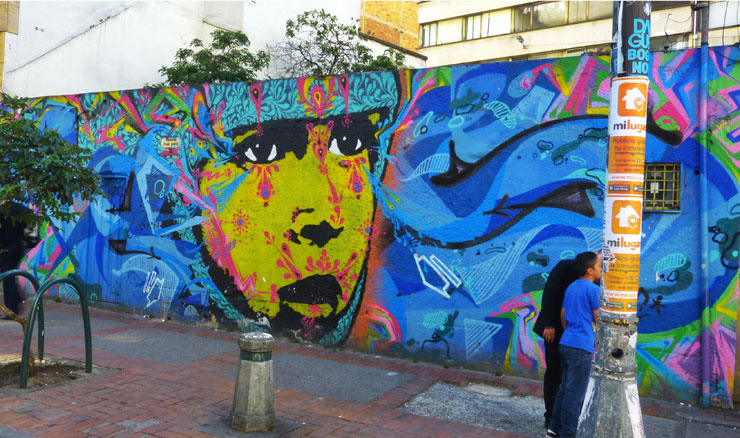
Bogotá : A Liberal Arroyo To Art Creates Exceptional Street Civilization
We arrived at the Bogotá airport in the evening. For convenience sake, we took a cab from the aerodrome to our adaptation in the heart of La Candelaria, an surface area of town known for its museums, beautiful compages and street art. I knew Bogotá was going to be as special equally far as its street art scene. I just did non know withal how incredible information technology was going to exist.
My introduction to Bogotá street fine art and graffiti was the highway from the airport into town, aka Calle 26—it was completely BOMBED. When I say bombed I mean there was non a single infinite free of art on the walls or tunnels of the highway for miles on end. The beautiful graffiti and street art along with countless tags adorning the walls fabricated me feel similar a child in a candy store. Immediately I knew Bogotá was going to exist special, a heaven for street art and graffiti.

Stink Fish. Bogota, Republic of colombia. (photograph © Yoav Litvin)
During my visit I was fortunate to run across 2 very active local artists: DJ LU (aka Juegasiempre), otherwise known as the "Bogotá Banksy" and CRISP, an Aussie transplant that has made the city his home. They were courteous and answered some of my questions.
Yoav Litvin: What makes the street fine art and graffiti scene and then unique in Bogotá? Please hash out the political groundwork in Bogotá in particular and Republic of colombia in general and some policies (legality etc.) that influence the great diversity of work on the streets. What'south special hither?
DJ LU: Bogotá'south treasure is its diversity, in every sense. Information technology has very eclectic architecture, interesting places, and is extremely multiracial. Urban expressions are not the exception; here you can find murals, tagging, hip hop graffiti, paste ups, stickers, characters, lettering and stencil work among others. Bogotá is an platonic playground for public expression. First of all, its urban structure is patchy making information technology ideally suited as far as context; there are many residuum spaces, remnants of highway constructions, parking lots and abased structures.
2d, the legislation is tolerant, then unless you are engaged in a very clear act of vandalism you won't take a problem with the law. Residents are as well becoming familiar with the practise then there is tolerance from the local population.

Toxicomano . Unknown . DJ LU . Bogota, Republic of colombia. (photo © Yoav Litvin)
CRISP: Bogotá is one of the well-nigh exciting, underrated and prolific urban art scenes on the planet. This is due to a combination of several factors, which take created a melting pot of creativity and expression. Firstly, at that place is a long history of ceremonious unrest, inequality and injustices in Colombia that brand street art and graffiti a stiff form of expression and protest for the people.
It actually has the longest running civil war in the world, over half a century of bloodshed!

Toxicomano . DJ LU . Lesivo . Bogota, Colombia. (photo © Yoav Litvin)
Secondly, information technology has a very tolerant legal arroyo to urban fine art compared to nearly other cities in the globe. It's non technically illegal but "prohibited", which provides a unique situation where grafiteros tin can take their time and paint in wide daylight. That said, an creative person still needs to be cautious of police depending on the type of street art you are doing and due to police history of brutality.
Thirdly, Republic of colombia has a rich resources of inspiration: its people, music, food, indigenous cultures, animals and plants from the Pacific, Andes, Amazon and Caribbean! This complex mix of factors makes Bogotá's urban art scene truly unique.

DJ LU Bogota, Colombia. (photo © Yoav Litvin)
Yoav Litvin: What motivates you in your work? Please discuss how your work is an expression of your evolution within the scene in Bogota.
DJ LU: My piece of work is motivated by reality. I'm interested in making people aware–through art–of lots of situations that affect u.s. every bit a society. The commencement project I started with on the street is the Pictogram project. It is based on semiotics and sign language. As information technology proposes very unproblematic designs it is intended to relay a message immediately. In this project I take designed more than than 60 pictograms that I have put up all over Bogotá and many other cities around the world in stencil course, stickers and paste ups.
Afterwards came the Street Pride project in which I took photographs of bearding people whose appearance I found aesthetically interesting and who were interacting with the public space and I used them every bit models for my work. I believe that advertisements and the media in general are fabricating idols for the people to follow and to speed upwardly consumerism. I desire to make the invisible visible, to bring attending to anonymous people who construct our street culture.

Crisp. Bogota, Republic of colombia. (photo © Yoav Litvin)
Crisp: I've always expressed myself through art from a very young age. In terms of street art I was a late bloomer. Despite an involvement and marvel in urban art, It was but when I came to Bogota that I truly became a street creative person! I met grafitero friends here who encouraged me to put my artwork up in the street. Street art has shown me that it'southward of import that our public spaces aren't controlled and dictated solely past councils, corporations, marketing companies, and formal art institutes.

Toxicomano. Bogota, Colombia. (photo © Yoav Litvin)
Yoav Litvin: How do you run across the future of street art and graffiti in Bogota?
DJ LU: I believe that the progress of street art and graffiti is adamant by a lot of factors: legal issues, trends, politics and economics. Graffiti and street art are trendy now in Bogotá, and this will most probable decrease. At that betoken only the ones that are doing information technology for existent will keep working outside.
Well-baked: The huge changes I've witnessed since 2001 through 2008 until the present are astounding. Bogota's urban art has exploded in terms of quality and quantity. Everywhere you look, walk and drive, you come across some form of creativity and expression on near every block in the city!
More often than not it is grass roots, passion-driven and totally devoid of the more corporate, council and gallery-organized and funded "street fine art" you see in many other cities in the world. In the near futurity I meet many talented Colombian artists finally getting the recognition, support and power to share their work with a wider international audience they deserve. Ironically this point isn't important to many grafiteros here.
It'southward the way of life, the friends, the culture, pure expression, fun, connecting with the public and the happiness this connexion with the street brings that'southward well-nigh important! In the future Bogota will be known as an urban art mecca but for all the right reasons!

Lesivo. Bogota, Colombia. (photograph © Yoav Litvin)

Guache. Bogota, Colombia. (photograph © Yoav Litvin)

Stinkfish. Bogota, Republic of colombia. (photo © Yoav Litvin)

APC . Stinkfish . FCO . Temor. Bogota, Colombia. (photo © Yoav Litvin)

Praxis. Bogota, Colombia. (photo © Yoav Litvin)

Frank Salvador . Sur Beat. Bogota, Colombia. (photo © Yoav Litvin)

Bastardilla wheatpaste afloat beneath a handful of dripping tags. Bogota, Colombia. (photo © Yoav Litvin)

Bastardilla. Item. Bogota, Colombia. (photo © Yoav Litvin)

El Pez. Bogota, Republic of colombia. (photo © Yoav Litvin)
<<>>><><<>BSA<<>>><<<>><><BSA<<>>><><<>BSA<<>>><<<>><><BSA
Please note: All content including images and text are © BrooklynStreetArt.com, unless otherwise noted. We similar sharing BSA content for non-commercial purposes every bit long equally yous credit the lensman(due south) and BSA, include a link to the original article URL and do not remove the photographer'due south name from the .jpg file. Otherwise, please refrain from re-posting. Thanks!
<<>>><><<>BSA<<>>><<<>><><BSA <<>>><><<>BSA<<>>><<<>><><BSA
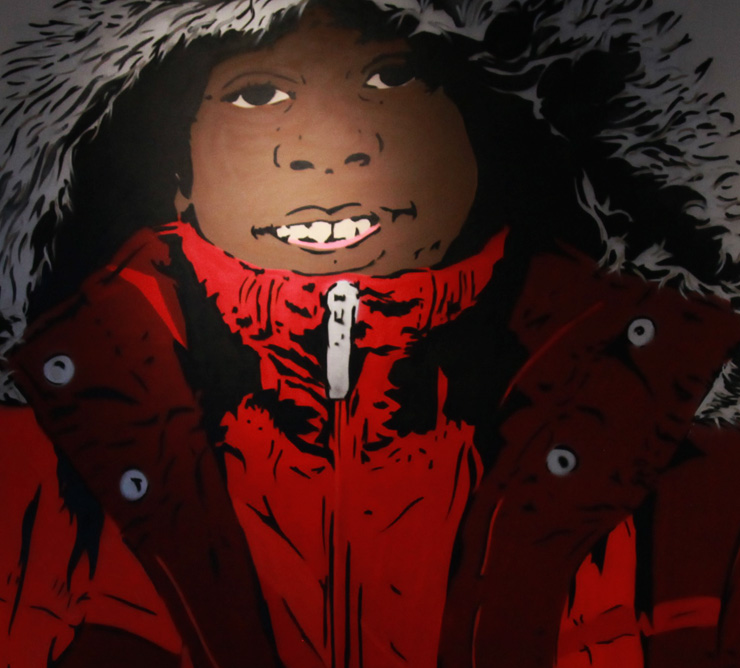
Sneak Peek "Concrete to Information" at Steinberg Museum
Curator and artist Ryan Seslow has pulled off an overview of fine art on the streets and the practices employed, minus the drama. And then much discussion of graffiti, Street Art, and public fine art practice tin concentrate on lore and turf war, intersections with illegality, the nature of the "scene", shades of xenophobia and class structures; all crucial for 1'south understanding from a sociological/anthropological perspective.
"Concrete to Data", opening this week at the Steinberg Museum of Fine art on Long Island, gives more than of the spotlight to the historical methods and media that are used to disseminate a message, attempting to forecast about future means of communicating that may effectively bridge the gap betwixt the physical and the virtual.

Joe Iurato. Detail. Concrete To Data. Steinberg Museum of Art. LIU (photo © Jaime Rojo)
Seslow has assembled an impressive cross section of artists, practitioners, photographers, academics, theorists, and street culture observers over a 5-decade span. Rather than overreaching to exhaustion, it can give a representative overview of how each are adding to this conversation, speedily presenting this genre'southward complexity by primarily discussing its methods alone.
Here is a sneak peek of the the concrete (at present transmitted digitally); a few of the pieces for the group exhibition that have gone up in the last week in the museum as the evidence is being installed.

Chris Stain. Detail. Concrete To Data. Steinberg Museum of Art. LIU (photograph © Jaime Rojo)

Cake. Detail. Physical To Data. Steinberg Museum of Art. LIU (photo © Jaime Rojo)

Lady Pink at work on her mural. Concrete To Information. Steinberg Museum of Art. LIU (photo © Jaime Rojo)

John Fekner. Detail of his stencils in place and ready to exist sprayed on. Concrete To Data. Steinberg Museum of Art. LIU (photograph © Jaime Rojo)

Henry Chalfant. Detail. Physical To Data. Steinberg Museum of Art. LIU (photo © Jaime Rojo)

Billy Mode. Detail. Concrete To Data. Steinberg Museum of Art. LIU (photo © Jaime Rojo)

Oyama Enrico. Detail. Concrete To Data. Steinberg Museum of Fine art. LIU (photo © Jaime Rojo)

Col Wallnuts. Item. Concrete To Data. Steinberg Museum of Fine art. LIU (photo © Jaime Rojo)
Concrete to DATA will be exhibited at the Steinberg Museum of Art, Brookville, NY January 26th 2015 – March 21st 2015.
Opening Reception – Friday, Feb 6th 2015 6PM -9 PM
Follow the news and events via – http://concretetodata.com
Follow @concretetodata on Instagram – #concretetodata
Curated past Ryan Seslow – @ryanseslow
Museum Manager – Barbara Appelgate
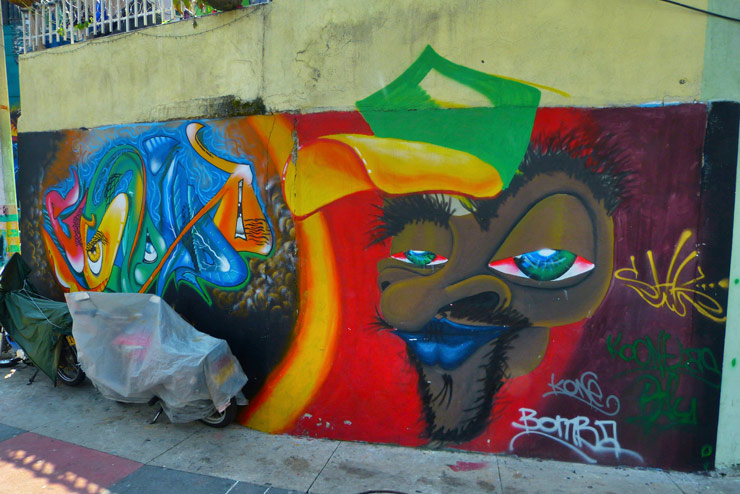
Customs Murals and the Vehement History of Comuna 13 in Medellin
San Javier, aka "Comuna 13", is considered the about dangerous, offense-ridden district in Medellín, the second largest city in Republic of colombia. Information technology has been plagued by violence at the hands of drug cartels, local gangs, guerillas and paramilitary groups all of whom seek control of its strategic location every bit a crossroads of illegal goods coming into and out of Medellín, and thus Colombia as a whole. In 2010, the neighborhood saw 162 murders for every 100,000 people, an astonishing 10 percent of all homicides in the city.

Comuna xiii. Medellin, Republic of colombia. (photo © Yoav Litvin)
Traveling through Medellín, I was intrigued to hear from a local fine art lover of a street fine art and graffiti project at Comuna 13 aimed at bringing art, education and peace to this embattled community. Using art equally an instrument for the promotion of peace has a bloody history in Comuna 13, where 10 hip-hop artists were murdered every bit they tried to endorse an end to violence.
Determined to meet the projection for myself, I sought a local guide who would agree to take me there. I was surprised to discover that in that location was a company that organizes tours of Comuna thirteen and the adjacent morning time at 10 a.chiliad. I met Juan Manuel, a friendly local resident who is bilingual and co-founder of "Notice Medellín".
For a couple of hours we walked together through the streets of Comuna 13, taking in all the beautiful fine art that is part of the "Medellín is painted for life" project. Throughout the tour the very knowledgeable Juan educated me on the local authorities's efforts to revitalize the community at San Javier, including the installation of an escalator arrangement aimed at helping residents get to and from work, gratuitous house pigment for residents in a diversity of colors and investment in the construction of nearby libraries that would cater to the communities largely younger population, steering them away from crime. According to Juan, these investments have led to a dramatic reduction in violence and a transformation of Comuna xiii.

Chota. Medellin, Colombia. (photo © Yoav Litvin)
I had the opportunity to ask Juan Manuel almost these changes at Comuna 13 with a focus on the part of street fine art:
YL: What is the role of art in Comuna 13?
JM: Fine art serves multiple purposes. It allows local artists to share their passion for art with the local community. Information technology'south a positive influence for younger troubled kids who take limited opportunities in Colombia. Many are discriminated against solely because of the notorious barrio they live in. The public art as well serves every bit a historical record with many of the murals documenting Medellín'southward violent past. Recently, several home-owners along the tour take approached me with an invitation to paint a mural on their walls to assistance ameliorate the reputation of their community.
YL: How has the government promoted the art and artists in Medellín?
JM: The local regime has been actively involved in the recruitment of artists to paint murals in Comuna 13 besides as diverse other locations across the urban center. The legal walls have been a large hit with local artists who are eager to create and share their passion with the residual of the metropolis. The local authorities continues to actively search for new areas throughout the city for displaying public fine art. In improver, the local authorities has sponsored artists by providing them with the budgetary funds to complete various projects throughout the city.

Artist Unknon. Medellin, Colombia. (photograph © Yoav Litvin)
YL: Do you believe the art has a positive part in affecting crime levels in Medellín? How?
JM: Yes. Walking tours like this would not be possible without the desperate changes in the community. A few years ago, violence was a daily occurrence in the community. But afterward the local authorities invested millions of dollars in paint for local residents and allowed local artists to pigment murals throughout Comuna 13, safety in the surface area has greatly improved. These acts have given many long-term residents faith in local politicians who risked political backlash. Locals now meet more and more than interest in their community from the government, businesses, residents from other parts of Medellín and a few foreigners like y'all who are eager to explore the transformation of Comuna 13.
YL: What are your plans for the time to come?
JM: Together with my partner Arthur, we are currently in the procedure of securing funding for an art project in Comuna 13. The goal is to invite artists from around the world to paint inspirational art projects aimed at promoting the customs.

Paola Delfin. Medellin, Republic of colombia. (photo © Yoav Litvin)
After our tour I returned to my hostel and told my hostess of my feel. She was horrified to learn that I visited Comuna 13 and told me that the but reason I was left unharmed was because I had the obvious look of a foreigner: "Me and my friends never go there. If you look local or Latino in full general, you lot are stopped, questioned, or worse… They are ever suspicious of young men who may exist from a rival gang." she said.
Most of the street fine art and graffiti in Comuna 13 was made by kids or young people that received graffiti classes in Casa Kolacho or Casa Morada, by social entities which work with immature people in some parts of this big infamously tearing customs.

Senor OK . Grena Cru. Medellin, Colombia. (photograph © Yoav Litvin)

REK. Medellin, Republic of colombia. (photo © Yoav Litvin)

Bomba . Kone. Medellin, Colombia. (photo © Yoav Litvin)

El Pole. Medellin, Colombia. (photograph © Yoav Litvin)

DEXS. Medellin, Colombia. (photo © Yoav Litvin)

Javid Jah. Medellin, Colombia. (photo © Yoav Litvin)

Kone . AXND. Medellin, Republic of colombia. (photo © Yoav Litvin)
Our thanks to Yoav for his contribution and for sharing his trip and observations with BSA readers.
<<>>><><<>BSA<<>>><<<>><><BSA <<>>><><<>BSA<<>>><<<>><><BSA Please annotation: All content including images and text are © BrooklynStreetArt.com, unless otherwise noted. Nosotros like sharing BSA content for non-commercial purposes as long equally you credit the photographer(due south) and BSA, include a link to the original article URL and do not remove the photographer'southward name from the .jpg file. Otherwise, please refrain from re-posting. Cheers! <<>>><><<>BSA<<>>><<<>><><BSA <<>>><><<>BSA<<>>><<<>><><BSA 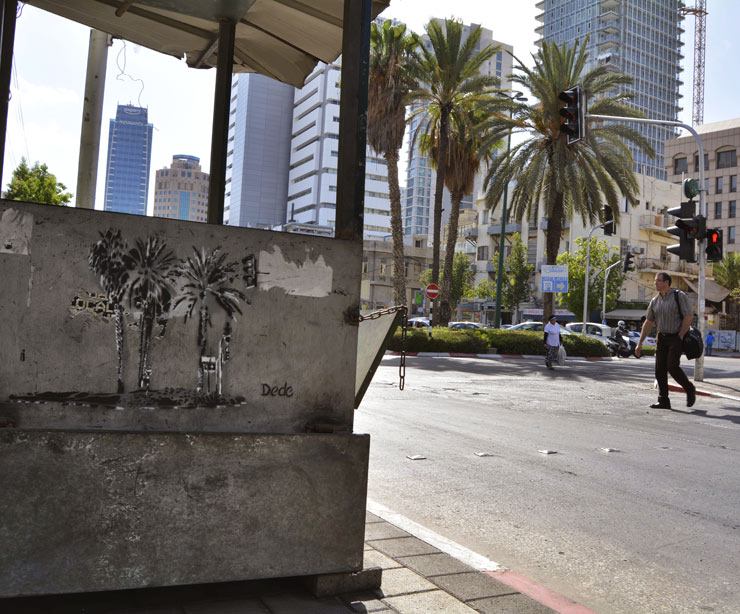
Dede Discusses New Site-Specific Stencil Serial In Tel Aviv
July 28, 2014 Artists, Interview
"Site-specific" is a term employed by some Street Art conceptualists frequently today, but the relevance of location to the piece on the street may not be as clear to the viewer as the artist would have intended even when information technology is the product of a high-minded process for selection. This is not the case in Tel Aviv where Street Creative person Dede is taking "site-specific" quite seriously in a new serial of pieces where a stenciled view of a urban center scene appears precisely where this view can also be observed with the blank eye. Past producing this visual double-have, the location and stencil placement instantly invoke a closer examination and consideration of just what is being called into view, and mayhap to enquire why.

Dede (photo © Yoav Litvin)
It could be a scene you otherwise would take overlooked, but somehow now it is elevated by the fact that the artist has taken the effort to cut and spray a stencil hither and probably did then with purpose. It'due south a highly effective method of sharpening our focus and we're glad that it has brought Yoav Litvin to BSA today to share his recent interview with Dede nearly the serial as well every bit to discuss his views on life in Israel during this time of intensified disharmonize with Palestine. Yoav also shares his photos from these new site-specific installations as well every bit other examples of the artists' stylistically eclectic offerings.
‾‾‾‾‾‾‾‾‾‾‾‾‾‾‾‾‾‾‾‾‾‾‾‾‾‾‾‾‾‾‾‾‾‾‾‾‾‾‾‾‾‾‾‾‾‾‾‾
Belonging, Territoriality and Healing in Israel: An interview with Dede by Yoav Litvin
Whenever I visit a city, I try to dedicate fourth dimension to venturing on the streets in search of art as a way of assessing the local and electric current creative vibe. Past chance, I was in Israel when the about recent violent conflict erupted betwixt the Israeli army (the IDF) and Hamas in the Gaza strip. During my two-week long visit there, I spent endless hours arguing against violence and for peace and reconciliation; confronting the powerful involvement groups and for the people.

Dede. Close up. (photo © Yoav Litvin)
Together with Dede, a local street artist, I walked through various neighborhoods in Tel Aviv in search of art. Seeing the beautiful and at times chaotically colorful walls, I once once again felt the positive and potentially healing power of art, even more so in this dire context of war. I have always believed street art can represent a creative, non-violent form of rebellion. It tin serve to challenge the powerful, the trigger-happy and the selfish and offer an unfiltered, free and raw voice- from the people to the people! As composer and playwright Jonathan Larson epitomized in his famous quote: "The opposite of war is not peace… information technology's creation!"
Here I talk with Dede most his current series of site-specific stencils, and how these may reflect some of the realities in this troubled town and function of the world. Additionally we see his about recent large-scale murals, which revolve around relevant issues of belonging, deportation and escape.
Yoav Litvin: What's your thought process behind these site-specific installations?
Dede: I began this ongoing site-specific serial of stencils at the end of 2013. Information technology stems from many thoughts/ideas on technique and the ways in which we are exposed to street art today. Importantly, I was very much influenced by a text written by the cultural critic Walter Benjamin, The Piece of work of Art in the Historic period of Mechanical Reproduction and its ramifications on our modern style of life.

Dede (photograph © Yoav Litvin)
Yoav Litvin: Why did y'all choose the locations you did?
Dede: Every location has its own reasons, each attempting to focus attention on an important issue within our modern urban reality. These include the housing crisis in State of israel, urban development and restoration of historical landmarks/buildings.
Yoav Litvin: In that location is a long-standing disharmonize surrounding territory in Israel. Practise your site-specific installations address it? How?
Dede: There is always conflict on territory/resources, perhaps everywhere in the globe but I see it conspicuously here in Tel Aviv. Just like in any backer society, existent estate here is bought and sold in accordance with personal interests and therefore tin can exist controversial in a customs. For example- see my stencil of the tower that was built in Neve Tzedek in Tel Aviv (beneath). The residue of the neighborhood is only two stories high and many residents were against the construction of such a tall building- there were petitions and protests but somewhen those with money won out. Country is expensive and Tel Aviv is prime number real estate in Israel. There is a abiding increase in housing prices and this is making Tel Aviv a city exclusively for the wealthy.

Dede (photograph © Yoav Litvin)
Yoav Litvin: I had a lot of fun shooting these stencil installations, trying to capture the art together with its subject. Are yous trying to create a dialog between artist and documenter? How do you lot view street art documenters within the scene, particularly with the central role of the Internet, social media and photo sharing?
Dede: Documentation is extremely important for street fine art, because of this art class'southward inherently ephemeral nature. However, seeing a photograph tin can never replace the feeling of standing in front of a slice and personally experiencing it. Documentation conveys the idea as best equally possible without experiencing it first hand. In this serial of stencils, documentation is a central theme.
Stencils are regularly cut based on photographs, and this series was sprayed at the location the pictures were taken. Thus, the photographer has a central office in capturing both field of study and the art information technology conveys. My notion was to challenge the documenter and in plough, the viewer of the photo. This piece of work was intended for an audition that relies on social networks for its street fine art consumption.

Dede (photograph © Yoav Litvin)
Yoav Litvin: How has your art evolved since terminal we spoke? Is it becoming more than personal or practice yous feel you are reaching out to the public with relevant issues to the community?
Dede: This is a question I enquire myself all the time. Honestly, I cannot really say what has changed in my fine art. I allow my art lead me, and do not try to lead information technology. I feel I am trying to evolve in both realms you mention, focusing on my personal style, simply also my interaction with the community, both locally and globally.

Dede (photo © Yoav Litvin)
Yoav Litvin: I find street art to be an excellent device for an artist to communicate with the surrounding communities. Do y'all try to appeal to a strictly Israeli audience in Tel Aviv? How do you lot engage the Palestinian population, for case in neighboring Jaffa?
Dede: Street art engages everyone everywhere, especially today in the age of the cyberspace. As an artist in Tel Aviv, Israel, I am aware that my art reaches Palestinians as well as Israelis. In fact, I often stand for with Palestinian artists, and am pleased when they enjoy, interested and/or are emotionally touched by my piece of work. I feel my work is a personal reflection that appeals to people everywhere, not only Israelis, Palestinians or any other category of people.
I honey painting in Jaffa, and during your last visit we walked through an abandoned building in Jaffa in which I and friends painted. Local residents are very positive and appreciate street art. I wish art could span all gaps between peoples here and everywhere.

Dede (photo © Yoav Litvin)

Dede. Jaffa every bit seen from Tel Aviv. (photo © Yoav Litvin)
Yoav Litvin: 1 cannot talk over Israel today without addressing the current violence. Has it affected your fine art? How and so?
Dede: The situation here is very complicated and disturbing. It is a conflict that has been going on for years. This disharmonize has affected my art and inspired me to create in many ways. I love Tel Aviv, merely during wars information technology is a difficult place to live in. One of the central themes in my works is the need to escape to a safer place, whether in the physical or emotional realm. This stems from dissimilar motivations; mental, social and political. I exercise not believe any citizen should live in a state of fear anywhere, and my art conveys these notions.

Dede and Latzi collaboration. (photo © Yoav Litvin)

Dede (photo © Yoav Litvin)

Dede (photograph © Yoav Litvin)

Dede (photo © Yoav Litvin)

Dede'due south studio. (photograph © Yoav Litvin)
Interview written, edited and translated by Yoav Litvin. Mr. Litvin is the author and lensman of the recently published book Outdoor Gallery – New York City by Gingko Press.
For more data regarding Yoav Litvin click HERE. For more than information regarding Dede, click Hither
<<>>><><<>BSA<<>>><<<>><><BSA <<>>><><<>BSA<<>>><<<>><><BSA Please note: All content including images and text are © BrooklynStreetArt.com, unless otherwise noted. We like sharing BSA content for non-commercial purposes as long equally you lot credit the lensman(s) and BSA, include a link to the original article URL and do not remove the lensman's proper name from the .jpg file. Otherwise, please refrain from re-posting. Thank you! <<>>><><<>BSA<<>>><<<>><><BSA <<>>><><<>BSA<<>>><<<>><><BSA 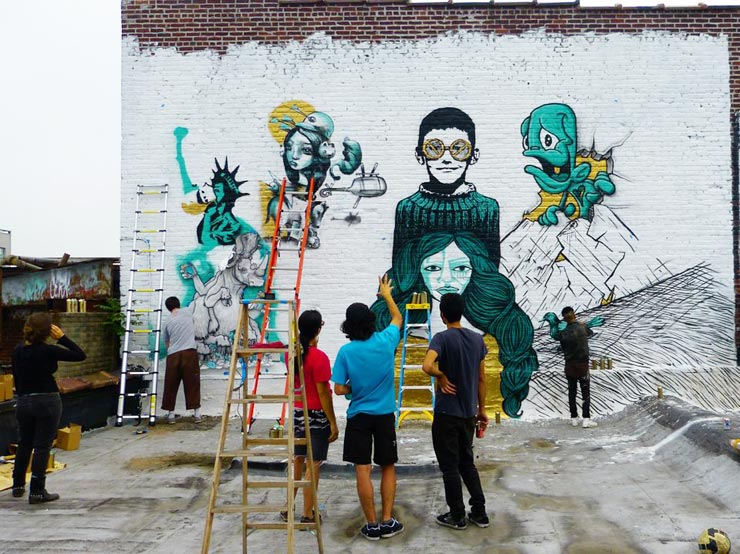
"Outdoor Gallery" Surveys Current Street Art Scene in NYC
February 20, 2014 Artists

Outdoor Gallery – New York City past Yoav Litvin
The outdoor gallery is the ane nosotros visit most and NYC is always front and heart in our heart even equally we branched out to near 100 other cities and towns last year. Outdoor Gallery – New York Metropolis is also the name of the brand new book by photographer and writer Yoav Litvin, who has spent the last couple of years shooting New York streets and coming together many of the artists who make the painting and wheat pasting that characterizes the class of 2014.

Outdoor Gallery – New York City past Yoav Litvin. Art by Chris Stain.
Published by Ginko Press, the large 235 page hardcover features nearly fifty street artists / graffiti artists whose work yous see here regularly (with the exception of ii or iii) along with comments and observations from the artists almost their practise, their experiences, and the electric current Street Art scene primarily in Brooklyn and Manhattan.
When Yoav told us of his hope to publish a book terminal year we offered any communication we could – merely primarily we advised him to stick to his vision and non to let anyone discourage him. A true fan of the scene, he has worked tirelessly to do just that and now he can share with you a personal survey and record of many of the artists who are getting upwardly today in New York.

Outdoor Gallery. New York City by Yoav Litvin. Art by Joe Iurato.
"Outdoor Gallery – New York City grew organically to embody my process of exploration and discovery on the streets of New York Urban center. It is a creation that was born out of love for New York City streets and their people, and focuses on artists as leaders with a unique and necessary part in a order that aspires for freedom and change," says Litvin in his introduction, and throughout the book you tin can sense the respect he has for the art and the dedication he has put into this project.
Conscientious to let the artists speak for themselves, he presents their work without commentary and with ample space given for expression. Using primarily his own photos, it is carefully edited and presented as an uncluttered and measured overview of each artists work.

Outdoor Gallery – New York Metropolis by Yoav Litvin. Art by Jilly Ballistic.
For us information technology is a proud moment to see someone's dream realized subsequently so much effort and dogged conclusion – especially in a scene whose challenges we are well familiar with. No i knows how hard information technology is to make something happen unless they practice it themselves. Then congratulations to Yoav for sticking to his vision and having the fortitude to terminate this and thanks to him on the behalf of the artists whom he is helping to receive recognition for their work as well.
To that stop, you are invited to the big launch party this Saturday at 17 Frost in Williamsburg. We'll be there and we hope y'all tin make information technology out for a not bad New York Street Art family reunion. You can't miss the entrance, it'due south been newly smashed past El Sol 25, Bishop 203, Royce and some other people we tin can't remember right at present but who volition remind us as presently as this goes upward ; ) .

Outdoor Gallery – New York Urban center past Yoav Litvin. Art by Gilf!
You tin find out more virtually it on the Facebook Event Page, merely we understand there will exist a newly debuted video from Dega Films, a special tribute to Army of One, and a full show of new works from many of the artists in the book, including;
Adam Dare, Alice Mizrachi, Army of 1 / JC2, Astrodub, ASVP, Billy Mode, Bisho203, Bunny M, Cern, Chris RWK, Chris Stain, Cope2, Dain, Dirty Bandits, El Sol 25, Elle Deadsex, Enzo and Nio, Free5, Fumero, Gaia, Gilf!, Hellbent, Icy and Sot, Indie 184, Jilly Ballistic, Joe Iurato, Kram, Lillian Lorraine, LNY (Lunar New Year), Miyok, ND'A, OCMC, OverUnder, Phetus88, QRST, Russell Male monarch, Shin Shin, Shiro, Sofia Maldonaldo, The Yok, Toofly, and Veng RWK.

Outdoor Gallery – New York City by Yoav Litvin. Art by Icy & Sot.

Outdoor Gallery – New York City by Yoav Litvin. Fine art by Hellbent.

Outdoor Gallery – New York Urban center by Yoav Litvin. Art past QRST.

Outdoor Gallery – New York City by Yoav Litvin. Front end and dorsum cover art by Bishop203, LNY, Alice Mizrachi, QRST, Gilf!, Cern and Icy & Sot.
Below is a look at behind-the-scenes of the making of the landscape for the embrace of the book.

Bishop 203. (photo © Yoav Litvin)

Icy & Sot balancing a stencil. (photo © Yoav Litvin)

Taking a footstep dorsum to assess the progress. (photo © Yoav Litvin)

The final piece. (photo © Yoav Litvin)
Outdoor Gallery – New York City will be launched in conjunction with an art exhibition this Saturday, February 22nd at 17 Frost Fine art Space in Williamsburg, Brooklyn. Click HERE for more details.
<<>>><><<>BSA<<>>><<<>><><BSA <<>>><><<>BSA<<>>><<<>><><BSA Please note: All content including images and text are © BrooklynStreetArt.com, unless otherwise noted. We similar sharing BSA content for non-commercial purposes every bit long equally you credit the photographer(s) and BSA, include a link to the original article URL and do not remove the photographer's name from the .jpg file. Otherwise, delight refrain from re-posting. Cheers! <<>>><><<>BSA<<>>><<<>><><BSA <<>>><><<>BSA<<>>><<<>><><BSA 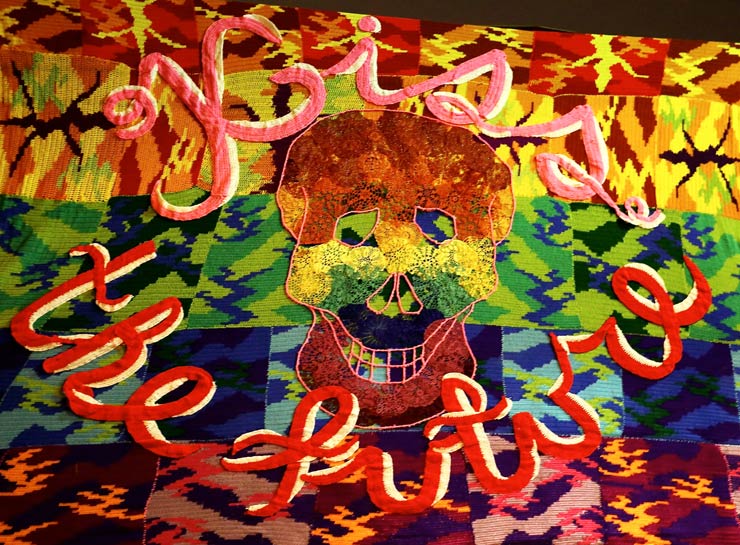
Images Of The Week: 01.05.14


It's been weeks since we had an "Images of the Week" posting with you lot, due to the end of the year spectacular we presented for 13 days; a solid cross department of the talented photographers who are documenting this important moment before information technology passes.
As a collection 13 From 2013 exemplified the unique and eclectic graphic symbol of Street Fine art and graffiti photography today. Each person contributed a favorite image and forth with it their insight and observations, ofttimes personal, very private, and with a real sense of authenticity. Each day we were sincerely grateful for their contributions to BSA readers and to run across the street through their eyes.
Cheers again to Yoav Litvin, Ray Mock, Brock Restriction, Martha Cooper, Luna Park, Geoff Hargadon, Jessica Stewart, Jim Kiernan, Bob Anderson, Ryan Oakes, Daniel Albanese, James Prigoff, and Spencer Elzey for thirteen from 2013. Also if you missed it, that list kicked off just later our own 2013 BSA Twelvemonth in Images (and video) were published hither and on Huffington Mail, all of which was too a great honour to share with you lot.
And so we bring back to y'all some documentation of moments before they passed – our weekly interview with the street, this week including $howta, Appleton Pictures, ASVP, BAMN, Chase, Dceve, Doce Freire, EpicUno, Hot Tea, Jerkface, Judith Supine, Leadbelly33, LoveMe, Meres, Olek, Rambo, Ramiro Davaro-Comas, Square, and Swoon.
This weeks height image is a reprieve from the wintertime nosotros've been enduring – a small mitt cut frog clinging to a verdant fern – created by Swoon and snapped during a visit to her studio over the holidays. (photograph © Jaime Rojo)

EpicUno (photograph © Jaime Rojo)

Rambo (photo © Jaime Rojo)

Leadbelly33 (photo © Jaime Rojo)

LoveMe (photo © Jaime Rojo)

BAMN (photograph © Jaime Rojo)

Judith Supine (photo © Jaime Rojo)

ASVP and Square (photo © Jaime Rojo)

$howta (photograph © Jaime Rojo)

JerkFace (photo © Jaime Rojo)

HotTea (photo © Jaime Rojo)

Olek's very latest piece completed on New year'due south Eve in Vancouver, Canada. (photo © Olek)

Olek. "Osculation the Futurity" detail. (photograph © Olek)

Meres has a message for Gerry. (photo © Jaime Rojo)

Meres (photo © Jaime Rojo)

Hunt (photo © Jaime Rojo)

Doce Freire in Sharjah City, UAE for the Al Qasba Festival. (photo © Doce Freire)

Dceve (photo © Jaime Rojo)

Appleton Pictures (photograph © Jaime Rojo)

Artist Unknown (photo © Jaime Rojo)

Ramiro Davaro-Comas (photo © Jaime Rojo)

Untitled. Manhattan, December 2013. (photo © Jaime Rojo)
<<>>><><<>BSA<<>>><<<>><><BSA <<>>><><<>BSA<<>>><<<>><><BSA
Please notation: All content including images and text are © BrooklynStreetArt.com, unless otherwise noted. We like sharing BSA content for not-commercial purposes as long as y'all credit the photographer(s) and BSA, include a link to the original article URL and practice non remove the photographer'due south name from the .jpg file. Otherwise, delight refrain from re-posting. Thanks!
<<>>><><<>BSA<<>>><<<>><><BSA <<>>><><<>BSA<<>>><<<>><><BSA
13 from 2013 : Yoav Litvin "Jury Duty"
December 19, 2013 Artists


Today Yoav Litvin shares a New York moment he defenseless in 2013 that can happen to yous sometimes in this Street Fine art and fashion capital, and tells u.s.a. what he was thinking when he defenseless it.

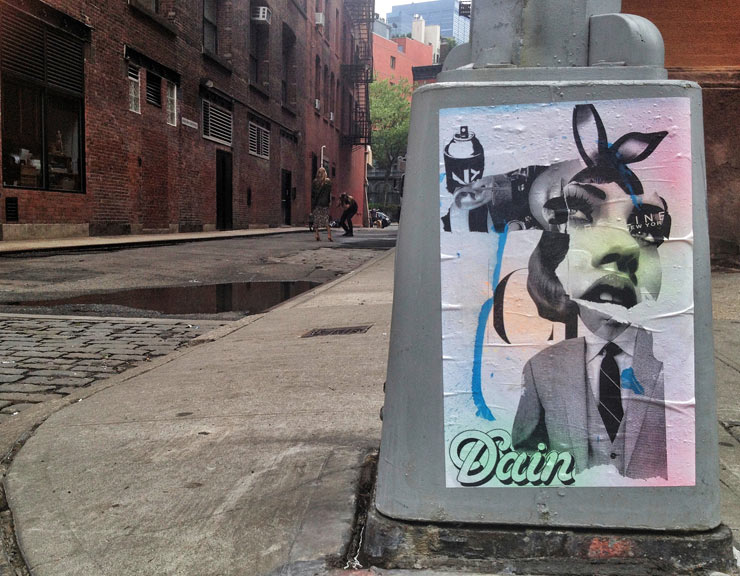
Dain in Tribeca, Manhattan, NYC 2013. (photo © Yoav Litvin)
"Jury Duty"
I was on jury duty in downtown Manhattan. It was lunch break but I wasn't hungry, so I decided to walk around and chase for art. I knew I was in prime street fine art territory and like some bloodhound, I trusted my street art "nose" to lead me in the direction of some cool pieces.
After crisscrossing several blocks with no luck, I ducked through an alley and noticed in the corner of my eye a speck of color on the base of a streetlamp that seemed out of place. Shifting my gaze, I immediately recognized that it was a wheatpaste by Dain, an artist I'd grown to admire.
Upon approaching the paste I saw in the distance an ongoing model shoot. Photographic camera in mitt, a photographer was continuing, crouching, sitting, and lying on the street, continuously taking pictures, manifestly searching for the all-time shot. Directly facing him a model was skipping around, laughing, swinging her purse, moving to the left, then to the right and occasionally stopping dramatically to face up him. Their movements were smooth, natural and flirtatious and I marveled at the site: it was beautiful, charming and intimate. Smiling, I redirected my attending back to Dain's slice. I felt a new kinship toward the beautifully collaged lady and realized we shared a very intimate moment. Right and so and there, she was my model, muse and inspiration and I had to find the shot that reflected her in all her dazzler.
I kneeled, took the shot and with a big smile headed back to jury duty.
~Yoav Litvin
Artist: DAIN
Location: Manhattan, New York. 2013
#13from2013
Check out our Brooklyn Street Art 2013 Images of the Year by Jaime Rojo here.
<<>>><><<>BSA<<>>><<<>><><BSA <<>>><><<>BSA<<>>><<<>><><BSA
Please notation: All content including images and text are © BrooklynStreetArt.com, unless otherwise noted. We like sharing BSA content for non-commercial purposes equally long equally you credit the photographer(due south) and BSA, include a link to the original article URL and do not remove the photographer's name from the .jpg file. Otherwise, delight refrain from re-posting. Thanks!
<<>>><><<>BSA<<>>><<<>><><BSA <<>>><><<>BSA<<>>><<<>><><BSA
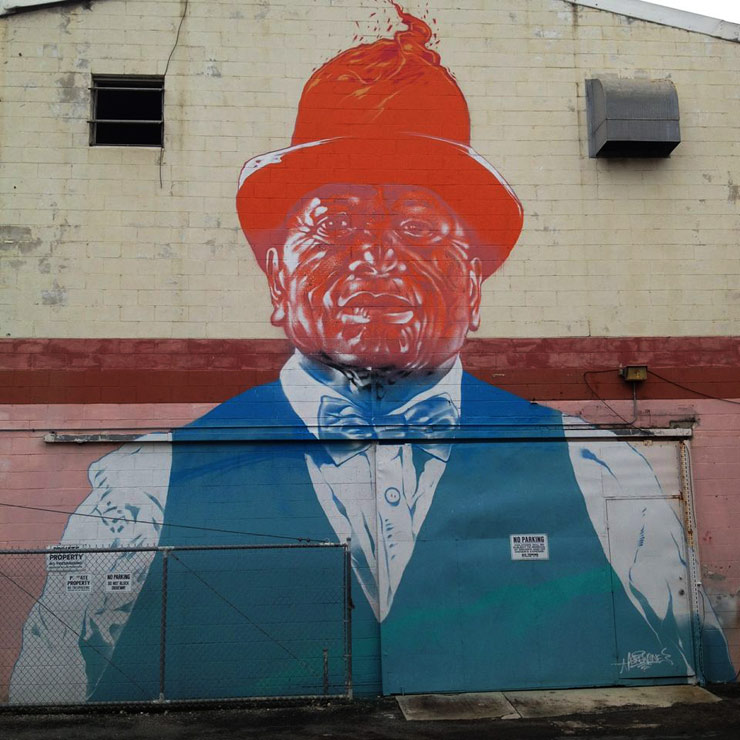
Street Art in Honolulu as Pow! Wow! Hawaii Enters Fifth Year
Before the twelvemonth wraps nosotros wanted to accept a look at images from Pow! Wow! Hawaii as it enters its fifth twelvemonth with a collection of images recently captured in Honolulu where it happens.
Begun by founder Jasper Wong in Hong Kong, Pw! Wow! Hawaii is a not-profit gathering in his hometown that he co-produces with some other artist named Kamea Hadar. In a promo video for the festival Wong says that the festival is about "beautifying a neighborhood, changing a neighborhood through art".

Rone and Wonder spell it out in their largest collaboration to date. (photograph © Yoav Litvin)
A criticism of street art festivals often leveled has been that the stars of the international excursion overpower the local tastes or are somehow insensitive to them, and the hip doesn't always respect the homegrown.
Pow! Wow! Hawaii steadily avoids that criticism by including local community throughout open participatory events and information technology makes sure to include artists who work with traditional motifs and values in their pieces, bringing ethnic cultures into the mix in a meaningful way.

Woes, Meggs, Peap, Tarr, Mr. Jago and Will Barras (photo © Yoav Litvin)
Since the rich pop colors of the modern age are also the visual lengua materna for these Street Artists and graffiti artists, it is mutual to see figures and patterns from the past updated with dial. The waterside commercial neighborhood along the southern shores of the isle of Oʻahu is called Kaka'ako and the proper noun itself has inspired some of the artists to include information technology in their pieces.
Recently photographer Yoav Litvin took a trip to the neighborhood where Pow! Wow! takes place and we bring yous some of the images from Honolulu to get a taste the work that has been left at that place by an estimated 100 artists since 2010.

Religion 47 (photo © Yoav Litvin)

Askew pays tribute to the Tuhoe Iwi and references the time of the Treaty of Waitangi (photograph © Yoav Litvin)

Nychos and Jeff Soto (photo © Yoav Litvin)

Scribe (photograph © Yoav Litvin)

Roids and Madsteez punch up the color when paying tribute to Rex Kalakua. (photo © Yoav Litvin)

Dal Due east (photograph © Yoav Litvin)

Ekundayo (photograph © Yoav Litvin)

Kamea Hadar and Rone (photo © Yoav Litvin)

Eddie Colla (photograph © Yoav Litvin)
From the website:
"Centered around a week-long consequence in Hawaii, POW! WOW! has grown into a global network of artists and organizes gallery shows, lecture series, schools for art and music, landscape projects, a large creative infinite named Lana Lane Studios, concerts, and live art installations beyond the globe. The central upshot takes place during Valentine's Twenty-four hour period week in Feb in the Kaka'ako district of Honolulu, and brings over a hundred international and local artist together to create murals and other forms of art."
For more near Pow! Wow! Hawaii click Here
<<>>><><<>BSA<<>>><<<>><><BSA <<>>><><<>BSA<<>>><<<>><><BSA Please note: All content including images and text are © BrooklynStreetArt.com, unless otherwise noted. We like sharing BSA content for non-commercial purposes as long as you credit the photographer(s) and BSA, include a link to the original article URL and do not remove the lensman's proper noun from the .jpg file. Otherwise, please refrain from re-posting. Thanks! <<>>><><<>BSA<<>>><<<>><><BSA <<>>><><<>BSA<<>>><<<>><><BSA 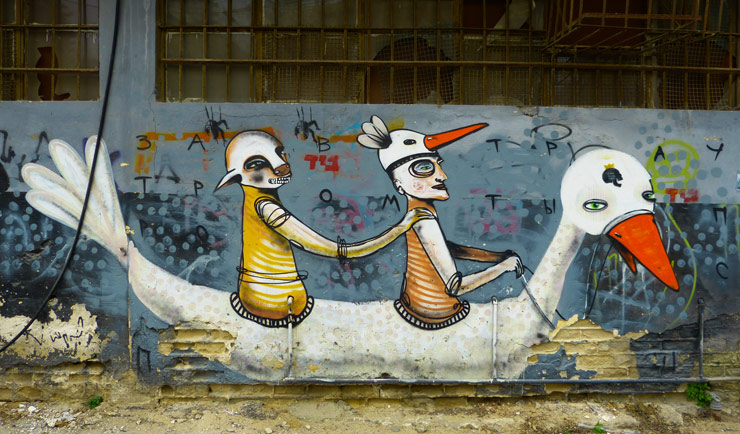
The New Face of Tel Aviv Street Art
April 24, 2013 Artists, Interview
Every bit more cities join the world Street Art scene, thanks largely to an enthusiastic youth culture sharing images across the Internet and handheld devices, yous see new artists popping up on the street nearly daily. While in that location certainly is a developing global visual vocabulary on walls that is influenced past high profile international stars, you will yet hear the local voice steering the Street Fine art chat as well.
For Tel Aviv, known by many every bit a vibrant party metropolis that never sleeps, the involvement in Street Art has been high and there has been a blooming scene in the final 5 years that mimics some of those international styles even as information technology clearly is developing it's own local artful.

Klone . Latzi (photo © Yoav Litvin)
Today we characteristic new images from local artists in Tel Aviv by a photographer and scientist from New York who lived for a while in this city on the Israeli Mediterranean coastline. An urban wanderer who pokes through fences, over walls, and forth small streets on the hunt for what'south new, Yoav Litvin says he "views the urban environment as the perfect melting pot betwixt humanity and nature, history and modernity, life and death." Nosotros talked to him about his recent explorations in the city and asked him to talk almost his observations in this snapshot of a growing scene.
Brookyn Street Art: What captured your attention about the Street Art scene in Tel Aviv?
Yoav Litvin: It's in your face! While walking in Tel Aviv, especially the city's southern parts, information technology was incommunicable to ignore; very diverse and colorful Street Art and graffiti are everywhere.

035 Crew (photo © Yoav Litvin)
Brookyn Street Art: Many of these shots are in abandoned buildings. For some photographers it is like an take chances discovering these sorts of spaces covered with art. What is information technology like for you?
Yoav Litvin: At that place's a lot of character in abandoned buildings; the aging walls, the colors, the disuse, the piles of rubble, the scattered tools or buckets of paint, the puddles of water, the beautiful imperfections. Every new space one discovers is surprising. You lot can sense a life history of an abandoned edifice, now turned bare skeleton. It's cozy in that sense, it is accepting, non judgmental and unpretentious. On the other hand, information technology keeps you on your toes with its broken stairs, precipitous edges, crumbling floors, stinking trash, used needles and even an occasional inhabitant who surprises you. I find that fine art works beautifully in such settings, blending and mutually complementing the great paint and occasional crevice.
As a photographer I find that abased buildings are fun spaces to play with lite and limerick. Nearly of these buildings have broken windows and doors, if whatever, letting in light that breaks, angles and reflects in a symphony of colors, lights and shadows.

Sboy . Dede (photo © Yoav Litvin)
Brookyn Street Art: Most large cities have a sure amount of piece of work on the street from international artists with a college profile. What fabricated you concentrate on merely the locals?
Yoav Litvin: I love seeing work produced past internationally well-known artists. But I find that when I walk the streets of any town, I particularly bask seeking art that is new and fresh to my eyes, fine art produced by local artists that are not every bit well known, many of them incredible talents that take just non had their international breakthrough. As a past inhabitant of Tel Aviv, I especially wanted to pay tribute to the local scene, artists who by nature integrate their city into their art, and their art into their city.

Wonky Monky (photo © Yoav Litvin)
Brookyn Street Art: Street Fine art can exist a practiced barometer of public tastes and a reflection of the culture that it is part of. Is there annihilation distinctly Israeli about the work you see represented, whether thematically or stylistically?
Yoav Litvin: From my contempo short visit to Tel Aviv, I noticed great diversity in both styles and mediums used. I besides noticed graff and street fine art ranging from simple tags any kid tin can do, to beautiful murals and elaborate pastes. As far as singled-out content, I did notice some politically oriented street fine art that directly addressed internal Israeli corruption, the ongoing occupation of the Palestinian territories and some social issues.
Other than that, I can't say I noticed something distinctly Israeli equally far as style, but I practise blame that on the shortness of my visit- With more time actually spent there, perchance I would be able to pick that upward. It'due south clear though that just like whatsoever urban artists in today'southward interconnected world, both their local scene and other artists worldwide influence Tel Aviv-based artists.
Brookyn Street Art: What is your favorite kind of shot equally a lensman and when practice you know you captured it?
Yoav Litvin: My favorite shot is when I spot something beautiful in good light, and can frame it perfectly so that information technology somehow relates to its environment in an interesting fashion. If it includes an opportunity to capture a peculiarly cute instant in time, that'southward peculiarly rewarding. When I snap such a shot, I usually just know it.

Raez (photo © Yoav Litvin)

Know Hope . Korse (photo © Yoav Litvin)

Klone . 035 Coiffure (photograph © Yoav Litvin)

Gidi (photo © Yoav Litvin)

Dede . Dioz . Ros Plazma (photo © Yoav Litvin)

Dede . Latzi (photo © Yoav Litvin)

Dioz . Untay (photo © Yoav Litvin)

Dioz . Wonky Monky (photo © Yoav Litvin)

Ros Plazma (photo © Yoav Litvin)

Ros Plazma (photo © Yoav Litvin)

Ros Plazma (photograph © Yoav Litvin)

Ros Plazma (photo © Yoav Litvin)

Klone (photo © Yoav Litvin)
<<>>><><<>BSA<<>>><<<>><><BSA <<>>><><<>BSA<<>>><<<>><><BSA
Please note: All content including images and text are © BrooklynStreetArt.com, unless otherwise noted. Nosotros like sharing BSA content for non-commercial purposes as long as you credit the photographer(s) and BSA, include a link to the original commodity URL and practice non remove the photographer'southward proper name from the .jpg file. Otherwise, delight refrain from re-posting. Cheers!
<<>>><><<>BSA<<>>><<<>><><BSA <<>>><><<>BSA<<>>><<<>><><BSA
This article also appears on The Huffington Post

Tel Aviv Street Creative person Dede Talks Nearly His City and His Work

Dede (photo © Yoav Litvin)
Interview with Dede
Conducted, translated and edited by Yoav Litvin
Yoav Litvin: What is the significance of art in the streets?
Dede: For me, street art began equally but a form that was just at that place. Over fourth dimension, information technology gained more than and more significance and has get the central and primary grade in which I work. Street fine art is challenging, surprising, dynamic, honest, exposed and always interesting.
Within the urban infinite I get the well-nigh inspiration and drive to create and produce a dialogue with the surround and the passersby. On the walls of Tel Aviv, I tin can initiate democratic and free debates and limited my opinions without the meddling or intervention of a curator or gallery. Above all it is a identify that enables me to declare my being in the present, and allows me to take part in creating the dynamic urban texture.

Dede (photo © Yoav Litvin)
Yoav Litvin: How are the current forms of street art a sign of our time?
Dede: In the reality in which we live, street art has new life. In the past, pedestrians would walk the streets and be exposed, via the urban hurry, to information and art. Today people spend more time sitting in front of the reckoner than walking the streets. With the current civilization of sharing and social networks, we can feel every bit though we are wandering the streets without really leaving home; ane can exist exposed to street fine art that is currently produced on the other side of the planet!
This opens up new possibilities, spaces, concepts and statements, making the street art medium even more relevant than before. The statements that emerge from the street reflect the status of the population, its hurting, suffering, happiness, etcetera. This enables a dialogue with and between the public in the city and the globe; artwork that tackles an issue or problem existing in a certain identify tin enhance awareness around the earth.

Dede (photo © Yoav Litvin)
Yoav Litvin: How did you lot become a street creative person?
Dede: I have never been able to telephone call myself a street creative person. Though my inspiration and free energy definitely come from the streets and returns to them, I believe that regarding the artist, the viewer has to decide for him or herself. Art is a concept that is difficult to grasp, almost abstract. It can be described or reviewed in all sorts of ways and everyone has different opinions nearly it. I create from a place of internal motivation and that makes it hard to explain; I produce regardless of what "art" is.
Yoav Litvin: Do you do studio work also? What is the difference for you?
Dede: I also work in my studio, mostly preparing for work in the street. In the studio I piece of work on sketches, models and tests that I later develop. Sometimes I accrue piece of work for a series of works to present in a slightly different manner than I would in the street with a different target audience in mind.

Dede (photo © Yoav Litvin)
Yoav Litvin: What is important for you to highlight in your work as a street creative person?
Dede: I estimate what's of import for me to highlight in my street art is that in that location is ever an culling; if at that place is a pressing issue, whether personal or social, you lot are allowed to stand up and say what you think about information technology and in so doing bring the upshot to the awareness of the public. Laws should not exist complacently accustomed, but rigorously reexamined. It is of import to be thoughtful, critical and form an educated opinion about them.

Dede (photo © Yoav Litvin)
Yoav Litvin: What does street art in Tel Aviv reflect about the city's urban life and nearly its urban civil society? Which is your favorite neighborhood?
Dede: Something well-nigh Tel Aviv made me instantaneously feel connected; I love this city and never get tired of information technology. It offers space walls and workspaces, a fast-paced vibe and a lively young crowd that is very admiring, appreciative and supportive. It is a city that does not correspond the remainder of Israel, only it has get a place characterized by diverse opinions that interact with and bear on the rest of the country. Each neighborhood has its ain uniqueness; together the neighborhoods produce a varied and interesting urban center at any time of day, culturally and in many other respects.
Yoav Litvin: Recount a memorable feel that has happened to you while working on a piece in the street.
Dede: Well-nigh every fourth dimension I become to work in the street I come back with exciting experiences and stories. I day during a placidity morning when I painted in an open parking lot in the Florentine neighborhood, I was on a ladder and a mom and her little boy approached me from behind. The boy asked his female parent what I was doing and his mom responded: "What he'due south doing is illegal, but this is his way of expressing himself." This was a very elementary statement and fabricated me realize something unique about my way of life.

Dede (photo © Yoav Litvin)
Yoav Litvin: How do you envision the future of street fine art in full general and in Tel Aviv in particular?
Dede: In my opinion it is not possible to predict the future. This art movement plays with and betwixt then many boundaries and stays fresh and always interesting, though, and perchance because there are many attempts to institutionalize and formalize it or to simply exclude information technology. Along with its exposure and rapid development, street art is introduced into unlike parts of the "mainstream". Some are even commercial even though street art is oftentimes illegal and directed against the system. Information technology seems to me that information technology will take fourth dimension for the involvement in the street art scene to wane.
In my opinion this is just the beginning; street art arrived hither in Tel Aviv relatively late, caught on very speedily and is still in its infancy. There are a lot of directions in which information technology could develop and many artists seek to develop their own styles. Like in any other field nosotros Israelis await at what is happening in the rest of the world and try to bring the unique Israeli context into the mix.

Dede (photo © Yoav Litvin)
Yoav Litvin: Please describe the creative techniques and materials you favor and why.
Dede: Being a curious person and not very rational, I use a multifariousness of techniques. I start thinking of what I want to say or practice and where I desire to say information technology and then only how to make information technology. I piece of work with stencils, pastes, gratis hand, installations, site-specifics and more. I use paint, spray pigment, paper and various industrial materials.
I promise that what somewhen echoes out of my piece of work is a path that shows my way of thinking and reasoning with statements that are probably however non completely articulate, merely volition be revealed gradually to both myself and viewer.

Dede (photo © Yoav Litvin)

Dede (photo © Yoav Litvin)

Dede (photo © Yoav Litvin)

Dede (photo © Yoav Litvin)

Dede (photo © Yoav Litvin)

Dede (photo © Yoav Litvin)

Dede. Sket . Task (photograph © Yoav Litvin)

Dede (photo © Yoav Litvin)

Dede (photo © Yoav Litvin)

Dede (photo © Yoav Litvin)
Dede'due south Info
Website: http://imdede.com/
Facebook: http://www.facebook.com/im.dede
Flickr: http://www.flickr.com/photos/dedeconfidential/
<<>>><><<>BSA<<>>><<<>><><BSA <<>>><><<>BSA<<>>><<<>><><BSA
Please note: All content including images and text are © BrooklynStreetArt.com, unless otherwise noted. We similar sharing BSA content for non-commercial purposes every bit long as you credit the lensman(s) and BSA, include a link to the original commodity URL and do non remove the lensman'south name from the .jpg file. Otherwise, please refrain from re-posting. Thanks!
<<>>><><<>BSA<<>>><<<>><><BSA <<>>><><<>BSA<<>>><<<>><><BSA
Source: http://www.brooklynstreetart.com/tag/yoav-litvin/
0 Response to "Yoav Litvin Making Israel Greater Again"
Post a Comment